
Xander Schwarz · 19 October 2026
How European Lab Networks Are Reshaping Reagent Supply Chains Through Ultra-Fast Verification Workflows
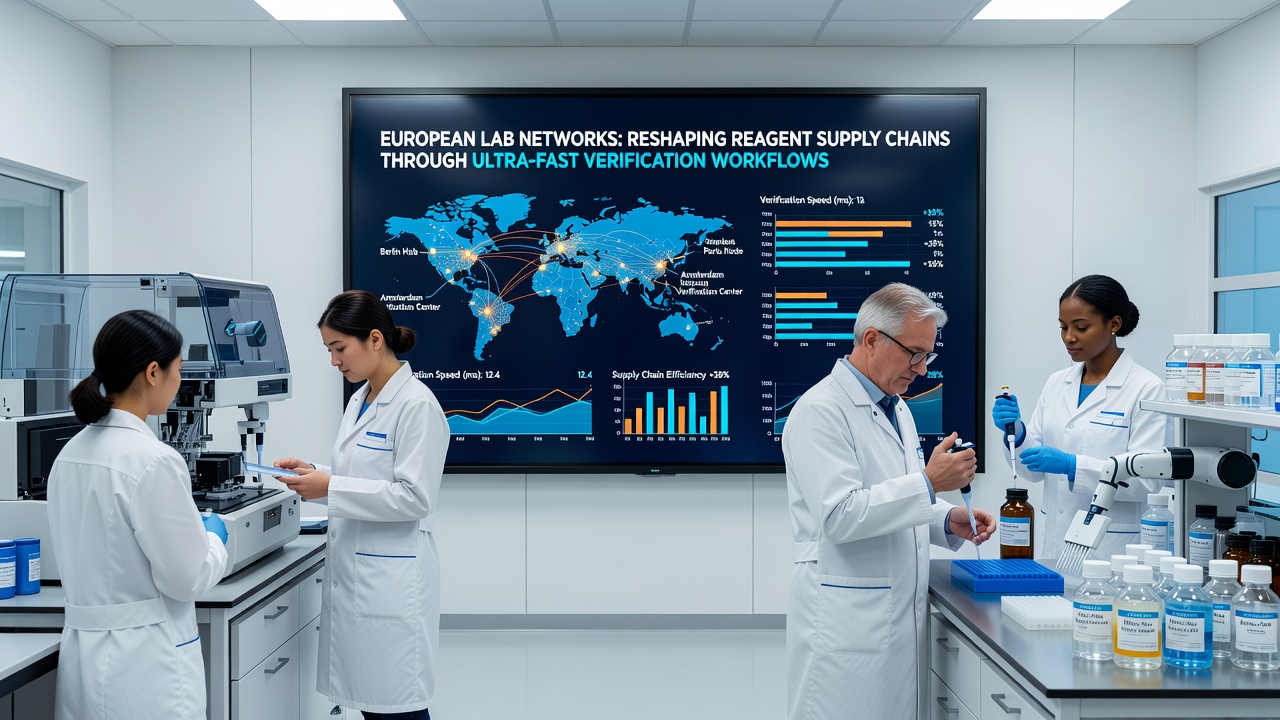
European laboratory networks have developed coordinated systems that accelerate reagent verification and integrate these processes directly into supply chain operations, and data from cross-border collaborations show measurable reductions in processing times across multiple member states. Researchers at institutions participating in these networks have documented workflows that combine automated testing protocols with shared digital platforms, allowing verification results to propagate through supply lines without repeated manual checks at each stage.
Network Structures Supporting Faster Verification
Consortia spanning Germany, France, the Netherlands, and Poland maintain shared databases that record verification outcomes in real time, while standardized protocols ensure consistency across sites with different equipment configurations. Studies conducted between 2023 and 2025 indicate that participating labs reduced average verification cycles from several days to under four hours in many cases, and these gains stem from parallel testing pipelines that run simultaneously rather than sequentially. Observers note that reagent suppliers now receive verification certificates within the same business day, enabling earlier dispatch and reducing holding times at distribution centers.
Technical Components of Ultra-Fast Workflows
Automated spectrometers and microfluidic analyzers feed results into centralized platforms that apply machine-learning filters to flag anomalies, and human operators review only those flagged cases instead of every sample. European research groups have published protocols showing that these filters maintain accuracy rates above 98 percent when calibrated against established reference materials, according to findings released by the European Commission Directorate-General for Research and Innovation. Integration with blockchain-based tracking further allows each verified batch to carry an immutable record that downstream users can query without additional laboratory intervention.
Supply Chain Adjustments Observed Across Regions
Manufacturers supplying academic and clinical labs report shorter lead times and lower buffer stock requirements once verification bottlenecks disappear, and logistics partners have adjusted routing schedules to match the accelerated release cadence. Figures compiled by the European Chemicals Agency reveal a 22 percent drop in average transit delays for verified reagents between 2024 and mid-2026, with the steepest improvements recorded in corridors linking Benelux facilities to Scandinavian research centers. Suppliers based outside the European Union have begun aligning their internal testing schedules with these network timelines to remain competitive, and several North American producers now submit pre-verification data packages that European labs can validate within the existing ultra-fast framework.
Developments Scheduled for October 2026
Network coordinators have announced an expansion round set for October 2026 that will incorporate additional testing nodes in Eastern Europe and introduce updated calibration standards for next-generation reagents, and pilot sites in Romania and Hungary have already completed infrastructure upgrades ahead of the rollout. The European Research Council has allocated funding to support training programs that will familiarize staff at new member labs with the verification software stack, ensuring uniform performance once the expanded network becomes operational.
Examples from Participating Institutions
One consortium centered at a Dutch university hospital demonstrated that switching to continuous verification streams cut reagent rejection rates by 15 percent over twelve months, and the same group shared its validation scripts with partners in Spain and Italy. Another project involving Polish and Swedish teams produced a modular verification unit that fits into existing clean rooms without major renovation, and early adopters reported full integration within eight weeks of delivery. These cases illustrate how localized adaptations feed back into the larger network and refine the shared protocols used by all members.
Regulatory and Standards Alignment
Alignment with ISO and CEN standards remains central to the verification workflows, and network participants submit aggregated performance data to regulatory bodies on a quarterly basis. Reports issued by the European Medicines Agency confirm that the accelerated timelines have not compromised traceability requirements, and auditors continue to access complete digital records during inspections. Canadian regulatory counterparts have expressed interest in adopting similar data-exchange formats to facilitate transatlantic reagent shipments, though formal agreements remain under discussion.
Conclusion
European laboratory networks continue to refine ultra-fast verification methods that directly influence how reagents move through supply chains, and the October 2026 expansion represents the next scheduled step in this ongoing integration. Data collected to date show consistent gains in processing speed and inventory efficiency across participating regions, while technical and regulatory frameworks keep verification standards uniform. Additional nodes and updated calibration tools scheduled for release later in 2026 will extend these capabilities further into Eastern Europe and beyond current membership boundaries.